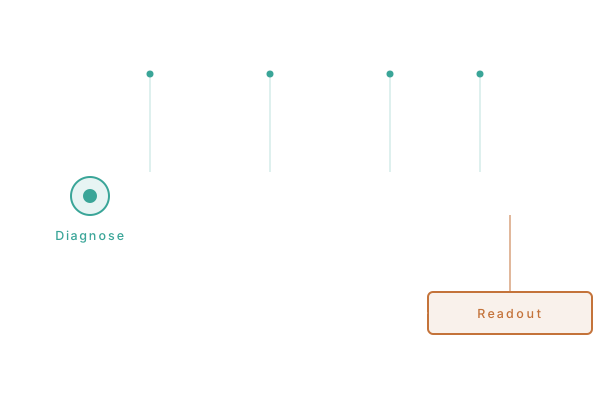
Diagnose
Map the current operating reality before money, platforms or programmes are committed.
ITZAMNA gives advisory work a repeatable backbone: capture evidence, compare perspectives, apply defined scoring, link findings to sources and sequence the next moves. Recommendations are grounded in what the business actually shows — not workshop opinion, vendor preference or generic best practice.
ITZAMNA exists to make advisory diagnosis more disciplined. It gives the work structure, evidence trails and consistency without pretending software replaces senior judgement.
Most growing businesses do not lack ambition. They lack a reliable picture of how the business actually operates across people, process, data, systems, integration, automation and control. ITZAMNA gives Telstar a structured way to build that picture before larger decisions are made.
The platform supports the diagnostic work. It helps capture input consistently, compare patterns across business areas, expose priority tensions and turn findings into a sequenced route forward. The judgement remains human. The method makes that judgement more traceable.
A structured diagnostic workspace for evidence-backed advisory work.
A documentation repository, generic dashboard, survey tool or automated consultant.
The spine runs beneath every diagnostic engagement. Each step connects to the next — evidence to finding, finding to recommendation, recommendation to disposition, disposition to sequenced action.
The value is created by combining structured human discovery with software-enabled consistency. Interviews expose the real story. Evidence keeps the work grounded. Scoring creates comparability. Sequencing turns insight into action.
Interviews expose the workarounds, ownership gaps, informal controls and decision bottlenecks that rarely appear in a survey or system report.
Evidence is assessed across capabilities, processes, data, applications, integrations, automation and controls so one visible symptom does not dominate the diagnosis.
Scoring and assessment logic provide a consistent baseline. AI can assist with pattern recognition and initial synthesis, but it does not replace evidence, scoring or professional judgement.
Findings are translated into priority actions, dependencies and next steps so leaders can see what to do first, what can wait and where risk needs active control.
The diagnostic does not produce a vague transformation roadmap. It produces an evidence-backed treatment path for each process, application, capability or workload assessed. Nine paths. Each one a defensible decision.
The AI-assist disposition means a human remains at the decision point. AI surfaces patterns, drafts analysis or flags anomalies — but accountability and sign-off stay with people. Risk is not delegated to the model.
AI-assist in the explainerThe AI-enable disposition means the workflow has been assessed as having sufficient data quality, control design and operating ownership for AI to act with confidence. This is a governance decision, not just a technical one. An agent that advises and an agent that acts are not in the same category.
AI-enable in the explainerSuitable for AI is not the same as ready for deployment. The question is not whether you trust AI agents. It is what they are allowed to do, who is accountable when they act, and whether your workflows, data and controls have been designed for that level of autonomy.
The five phases keep the work sequenced. They prevent the common pattern of selecting systems, launching automation or committing to AI before the operating model is understood.
Walk the decision chain step by step
Map the current operating reality before money, platforms or programmes are committed.
Shape a coherent target direction across the business, not just the technology estate.
Prioritise the next moves in the right order so change reduces risk instead of multiplying it.
Move from design into execution with enough clarity to avoid avoidable rework.
Embed the change so the business becomes easier to run, govern and improve.
Diagnose is where the business stops relying on surface symptoms and starts building an evidence-backed view of what is really happening. It combines structured interviews, artefact review, operating observations and system signals to expose where friction, duplication, weak ownership and hidden manual work are creating drag.
Architect translates diagnosis into a practical target shape. It connects capabilities, processes, data, applications, integrations, automation and controls so proposed change does not optimise one area while stressing another. The point is not to create abstract diagrams. It is to clarify how the organisation should operate and what technology needs to support.
Sequence turns insight and target direction into an ordered route forward. It separates urgent constraints from attractive distractions, identifies dependency order and makes trade-offs visible. This is where the business avoids trying to fix everything at once or funding the most visible issue while leaving the structural cause untouched.
Deliver is where the agreed sequence becomes controlled action. The focus is keeping delivery connected to the evidence and architectural intent established earlier, so implementation does not drift back into isolated workstreams, vendor defaults or local optimisation.
Stabilise ensures the change holds after the initial programme energy has passed. It reinforces ownership, measurement, controls, operating rhythm and learning loops so the business does not slide back into fragmented workarounds or unmanaged complexity.
The aim is not to create more documentation. The aim is to give leaders a clearer view of what is wrong, why it matters and what should happen next.
A clear view of operating friction, structural weaknesses and priority constraints — connected to the evidence that supports each finding.
Issues linked back to interviews, observations, artefacts and assessed signals — not inferred from generic best practice.
Perspective gaps across teams, functions or business units made visible so the diagnostic conversation reflects reality, not assumption.
A practical route that separates immediate moves from later design and delivery work — with dependencies, confidence and time-to-value visible.
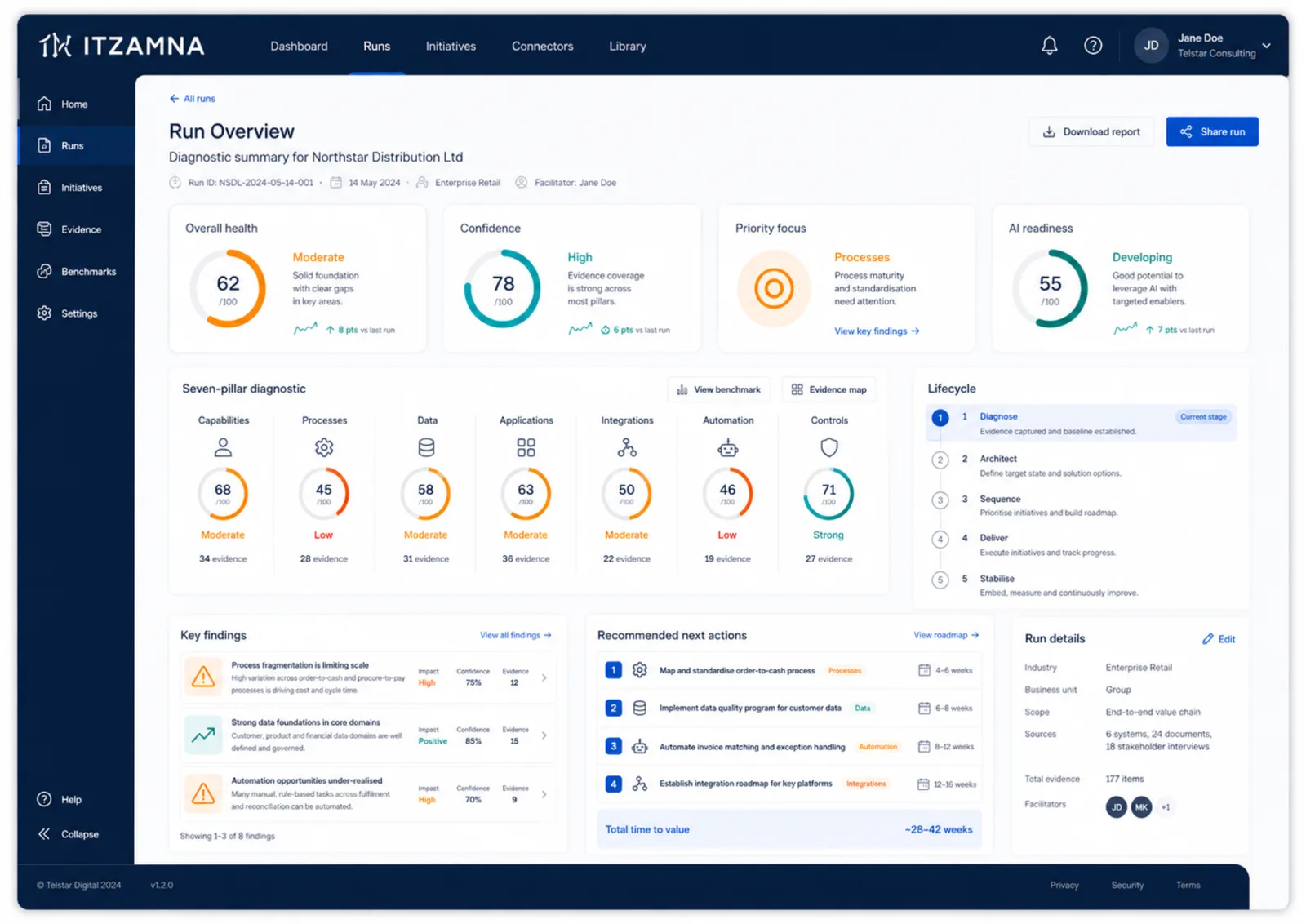
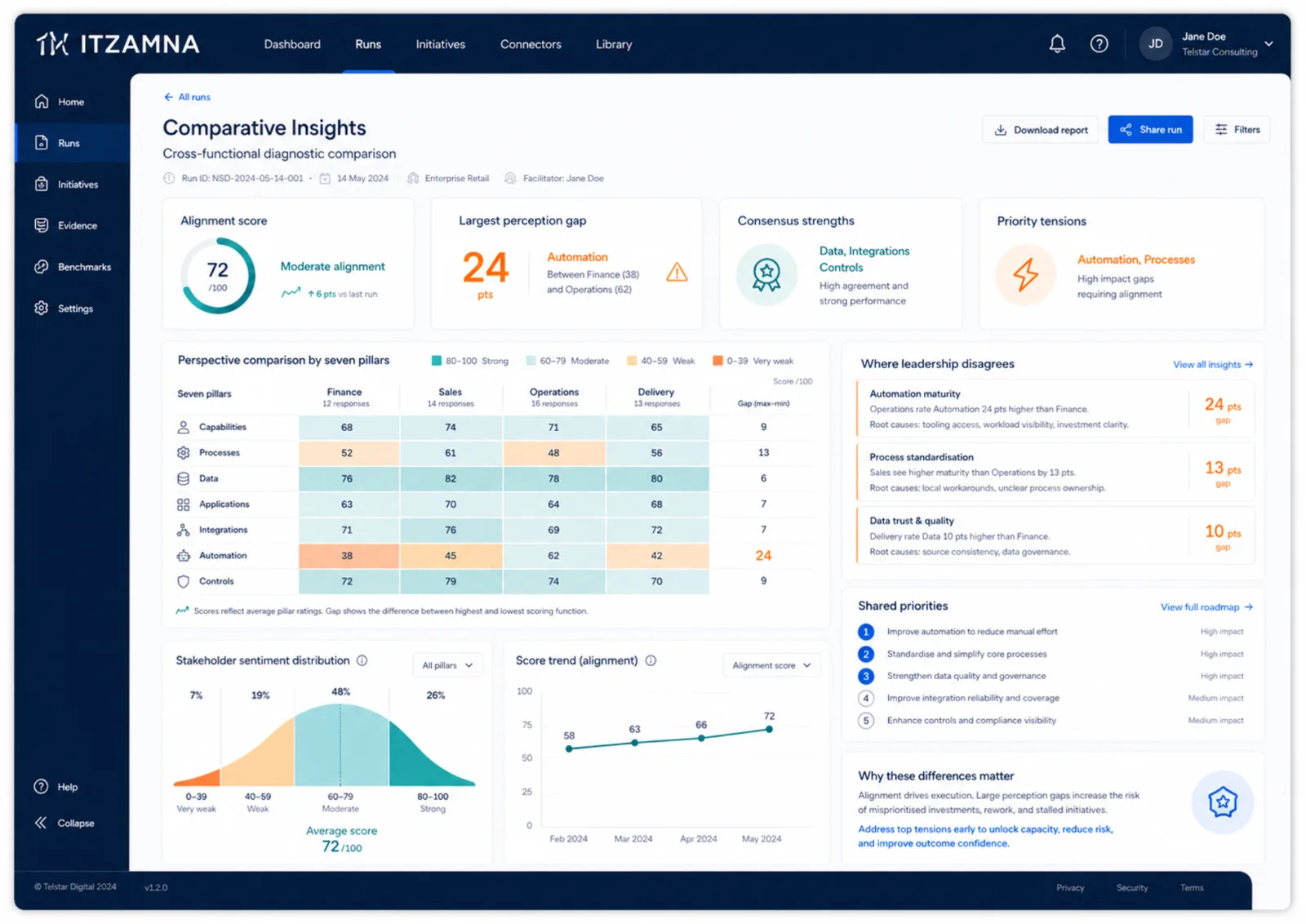
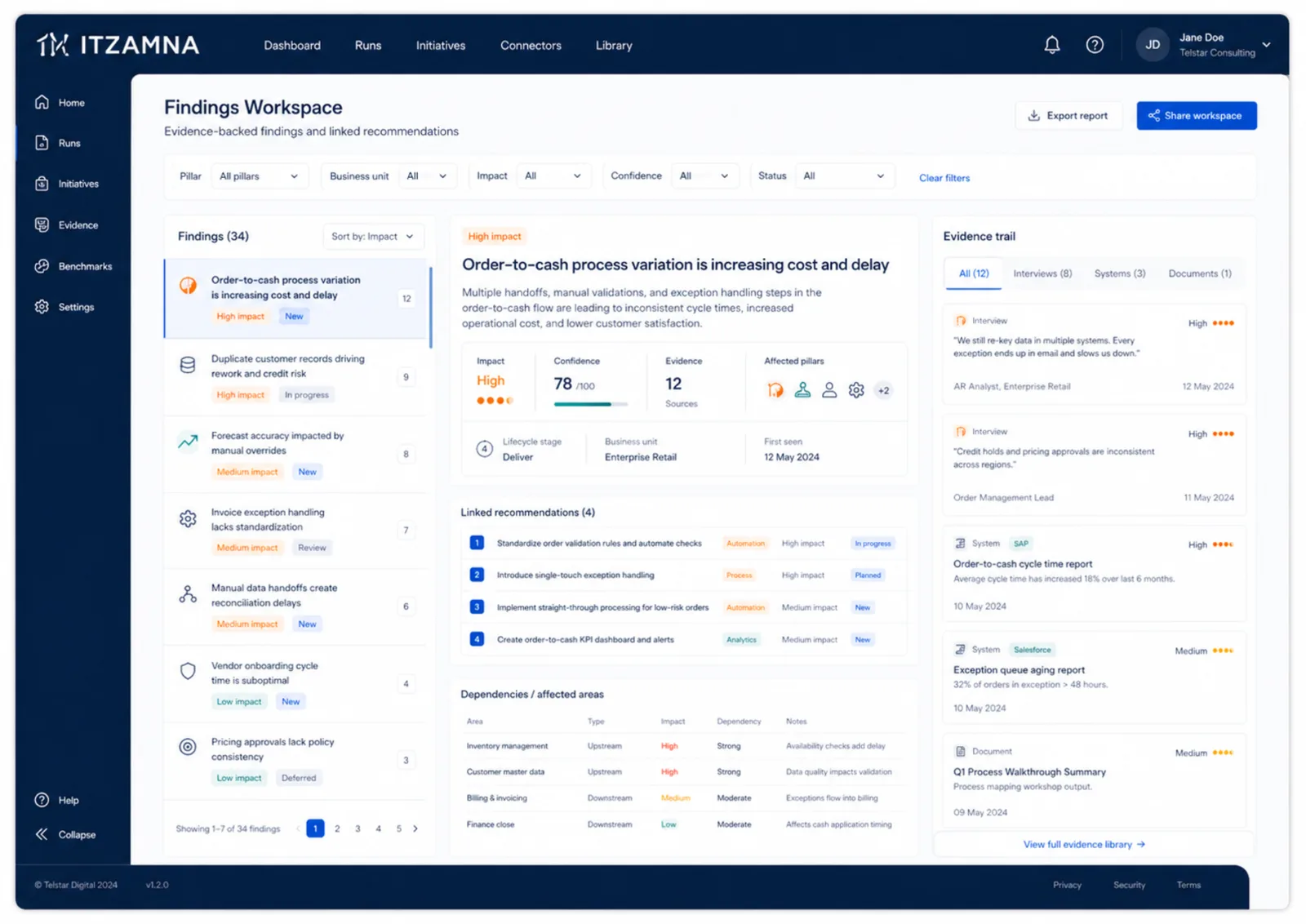
These examples show the type of view ITZAMNA is designed to support: summary health, comparative insight, evidence-backed findings and sequenced action.
Overall diagnostic health, confidence, priority focus, findings and next actions in one place.
A view of where business areas agree, diverge or expose hidden operating tension.
Findings connected to sources, affected pillars, recommendations and evidence trails.
Together, they help leadership teams see what is wrong, why it matters and what should happen next before committing to larger transformation or AI investment.