Modernisation and AI readiness start by knowing what to fix.
Through a Focused Diagnostic Sprint — a short, structured engagement — Telstar Digital shows growing businesses where operational friction, fragmented systems, weak data and unclear decision-making are slowing progress, then turns that picture into a practical sequence of improvement.
Practical support for the points where growth starts creating drag.
The work is framed around buyer situations, not abstract consulting categories. Each route is designed to create clearer decisions before larger budget, platform or programme commitments are made.
The business is getting harder to run, not easier.
Teams are working hard but the business still feels slow, manual or inconsistent. Workarounds have become the normal way of operating, and nobody is quite sure where the real bottleneck is.
Related thinking: clarity before spend → Systems and data complexityTools have multiplied but clarity has not improved.
Reporting is unreliable and no one fully trusts the operating picture. Similar capability exists in multiple systems, ownership is unclear, and the cost of the sprawl is hidden.
Explore the Seven Pillars → AI readiness and automationThe board wants AI progress but the foundations feel uncertain.
Suitable in principle does not mean ready in practice. The gap between the two is where most programmes fail — weak data, unclear ownership, fragile integrations and missing controls.
Related thinking: AI readiness → Modernisation sequencingToo many possible fixes, not enough clarity on what to do first.
The problem is not knowing what to do — it is knowing what to do first, what depends on what, and what spend should wait until the foundations are more solid.
Explore sequencing →A five-stage route from uncertainty to controlled change.
Each stage has a clear job. Select a stage to see what it does — the full method lives in ITZAMNA.
Find what is actually slowing the business down.
Map the current operating reality — clarity before spend.
Walk the full method in the explainerShape a coherent future state.
Shape a coherent target direction across the business, not just the technology estate.
Walk the full method in the explainerDecide what to fix first.
Prioritise the next moves in the right order so change reduces risk instead of multiplying it.
Walk the full method in the explainerMove from plan to controlled change.
Move from design into execution with enough clarity to avoid avoidable rework.
Walk the full method in the explainerMake the improvement stick.
Embed the change so the business becomes easier to run, govern and improve.
Walk the full method in the explainerFive things leadership can act on.
In four to six weeks, Telstar captures evidence across the Seven Pillars, compares perspectives, identifies the highest-impact constraints and turns the findings into a practical, sequenced action plan. Best when the business has fragmented systems, weak reporting, unclear ownership, or pressure to modernise without a reliable view of current reality.
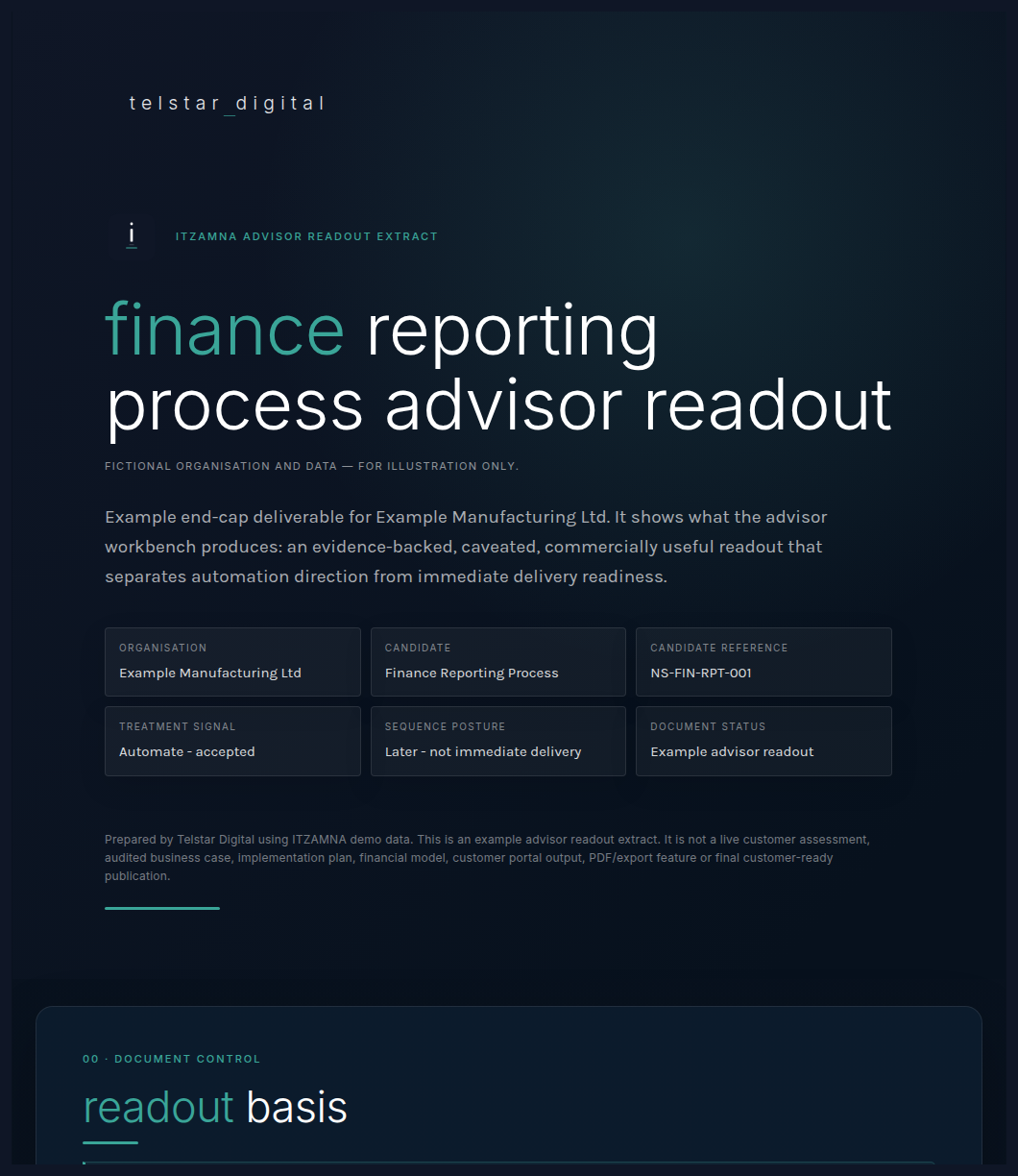 Illustrative example
What's inside
-
01
Executive summary Written to be read by an MD, CEO or board — not a technical team.
-
02
Evidence-backed findings Structured findings across all seven pillars, connected to what was observed and heard.
-
03
Prioritised recommendations A ranked view of what to address by impact, urgency, dependency and risk reduction.
-
04
Sequenced roadmap Quick wins, near-term fixes and structural improvements — with dependencies made visible.
-
05
Board-ready pack Clear enough to share in a board meeting, specific enough to act on.
Evidence before commitment. Architecture before acceleration.
Telstar is not trying to sell another generic roadmap, vendor-led recommendation or opinion-heavy workshop. The work is designed to create a clearer operating picture and a safer decision sequence before larger commitments are made. We turn scattered business symptoms into evidence-backed decisions about what to stabilise, simplify, automate, AI-assist, AI-enable, retire, replace or rebuild.
- Another generic transformation roadmap.
- A vendor-led platform recommendation.
- A workshop that produces opinions but little evidence.
- Pressure to adopt AI before the foundations are understood.
- A broad programme that starts before the real problem is clear.
- Evidence-backed diagnosis before any commitment.
- Architecture-led sequencing of what to fix first.
- Clear trade-offs leadership can understand and act on.
- AI readiness assessed against real data, process and control foundations.
- A practical next step, not a multi-year programme proposal.
And on AI specifically: an agent that advises and an agent that acts are not in the same category. Governance must reflect what each agent is allowed to do — and who is accountable when it does it.
Use the Mini Diagnostic for an initial signal.
Or speak to Telstar about a focused diagnostic engagement when the business needs a clearer investment route.