
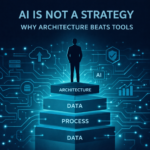
Why Architecture, Not Tools, Will Decide Who Actually Wins
Every organisation I speak to is “doing AI”.
They have pilots.
They have vendors.
They have slides.
What they don’t have — in most cases — is a strategy.
That’s not a semantic complaint. It’s the root cause of why so many AI initiatives stall, fragment, or quietly disappear six months later.
Because AI is not a strategy.
It is a capability. A force multiplier. An accelerant.
And like every accelerant, it magnifies what already exists — good or bad.
The Category Error Everyone Is Making
Let’s be blunt.
Treating AI as a strategy is a category error.
Strategy answers questions like:
- What outcomes matter?
- Where do we choose to compete?
- What capabilities must exist to sustain advantage?
- What trade-offs are we making?
AI answers none of these.
AI answers:
- How faster
- How cheaper
- How more automated
That’s not direction. That’s execution.
When organisations declare “our AI strategy”, what they usually mean is:
- a tooling roadmap
- a procurement plan
- a centre of excellence
- a set of pilots detached from operations
None of those are strategy. They are activity.
Why AI Amplifies Failure More Than Success
AI doesn’t fix broken systems.
It scales them.
If your organisation already suffers from:
- fragmented processes
- inconsistent data
- unclear ownership
- siloed decision-making
- weak architectural coherence
AI will not resolve those issues.
It will:
- automate inconsistency
- accelerate confusion
- institutionalise poor decisions at scale
This is why so many AI programmes feel impressive and deliver so little.
They are being dropped into environments that lack the structural conditions required for them to work.
The Real Constraint Is Not Intelligence — It’s Coherence
Most enterprises do not have an intelligence problem.
They have a coherence problem.
They don’t lack data.
They lack shared meaning.
They don’t lack automation.
They lack end-to-end accountability.
They don’t lack tools.
They lack a unifying architectural frame that explains:
- how work flows
- where decisions are made
- which systems are authoritative
- how change propagates safely
Until those questions are answered, AI is just noise with momentum.
Architecture Is the Missing Discipline
This is where architecture re-enters the conversation — not as documentation, not as governance theatre, but as decision structure.
Real architecture does three things before AI is introduced:
- It stabilises intent
Clear business outcomes. Clear capability boundaries. Clear ownership. - It establishes structural truth
What is the system of record?
What is the system of engagement?
What is the system of automation? - It defines safe leverage points
Where intelligence can be embedded without breaking the whole.
Without this, AI initiatives default to:
- local optimisation
- shadow automation
- uncontrolled agent sprawl
- governance retrofitted after damage is done
That is not innovation. It’s technical debt with a marketing budget.
Tools Don’t Create Advantage — Systems Do
There is a persistent belief that competitive advantage comes from early adoption of tools.
It doesn’t.
Advantage comes from:
- how consistently decisions are made
- how quickly feedback loops close
- how safely change can occur
- how well humans and systems collaborate
AI can enhance all of these — if the system is designed to support them.
Otherwise, competitors with fewer tools and better architecture will outperform you every time.
The Organisations That Will Actually Win
The winners in the AI era will not be those with:
- the biggest models
- the most vendors
- the loudest announcements
They will be the ones who:
- treat AI as part of an operating model, not a programme
- embed intelligence into processes, not PowerPoint
- design for human judgement first, automation second
- invest in architectural clarity before acceleration
In other words:
they will build systems that think, not tools that impress.
A Final Reality Check
If your AI initiative cannot clearly answer:
- What business capability does this strengthen?
- What decision does this improve or replace?
- What architectural boundary does it respect?
Then you don’t have an AI strategy.
You have an experiment.
Experiments are fine.
Pretending they are strategy is not.
If you want AI to matter, stop asking what can we automate?
Start asking what system are we building?
That question — and the architecture behind it — will decide who actually wins.